‘’How We Evaluate, Decide and Plan the Right Treatment for You’’
Hello everyone again,
Today, I will try to explain in a comprehensive way the most frequently asked questions by our patients who apply to ETH Dental Oral and Dental Health Polyclinic, by gathering them under a single title. My aim is to eliminate the uncertainties in your mind during this process and help you gain a more informed perspective.
In fact, I completely understand why our patients experience confusion at this point. As someone who has worked in academia for many years, I have trained numerous dentistry students and also provided advanced level courses to colleagues undergoing specialization training. The most significant gap I have observed throughout this process is the insufficient development of the ability to evaluate the patient as a whole.
It should be clearly stated that in a field where even a newly graduated dentist may have difficulty determining indications in certain cases, it is not always possible for patients to fully grasp all advantages and disadvantages through a single explanation. Therefore, this confusion is completely natural.
My purpose in writing this article is not to make a diagnosis for a patient, but to clarify the reasons behind a given indication and to transparently present what we consider when evaluating a patient.
In our own practice, based on the experience we have gained through a multidisciplinary approach, I will share with you the criteria we use when making treatment decisions.
Since this topic is quite comprehensive, I will proceed by dividing it into sections to make it more understandable.

Implant or Bridge?
I lost a tooth, should I get an implant or a bridge?
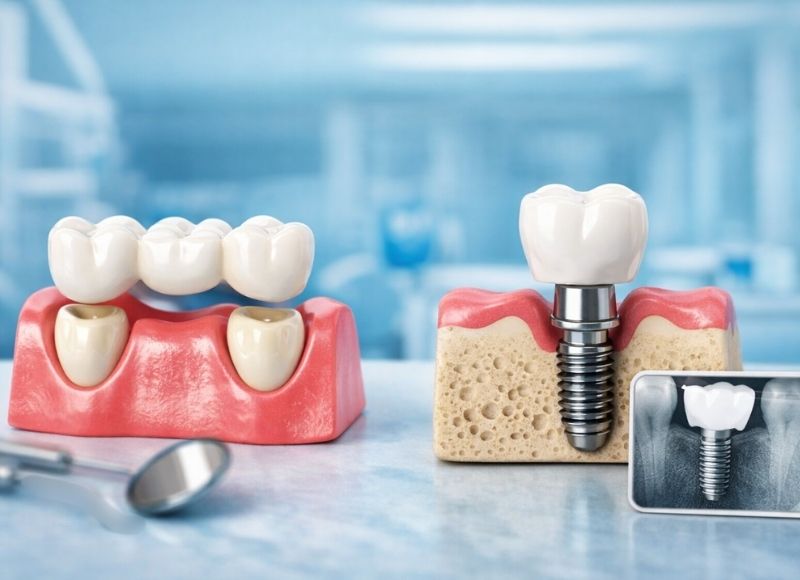
There is no single correct answer to this question. The decision for each patient is made by evaluating the condition of the missing tooth area, the health of adjacent teeth, bone structure, and overall oral health together. If the adjacent teeth are healthy and the bone is sufficient, implants are generally the first choice. However, in some cases, a bridge may be a more suitable option.
Which one is healthier and longer lasting?
When performed with the correct indication, both implants and bridges can be used successfully for many years. Implants are biologically more conservative since they can be applied without intervening on adjacent teeth.
Bridges, on the other hand, are successful when properly planned but require the reduction of adjacent teeth.
Which one is more suitable for my oral structure?
This is entirely a personalized evaluation. Bone volume, gum health, chewing forces, aesthetic expectations, and oral hygiene habits are all considered together to determine the most appropriate treatment plan.
Can everyone get implants?
No, implants cannot be applied to every patient. In patients with insufficient bone volume, uncontrolled systemic diseases, or poor oral hygiene, implant treatment may be risky. In such cases, alternative treatment options are considered.
Do healthy teeth have to be cut for a bridge?
In classical bridge treatment, the teeth on both sides of the missing tooth space need to be reduced. Therefore, when completely healthy teeth are present, the implant option is usually prioritized. However, in teeth that already have large fillings or damage, a bridge can be a logical option.
What if there isn’t enough bone for an implant?
Bone deficiency does not make treatment impossible. Bone grafting, sinus lifting, and other advanced surgical procedures can increase bone volume and make implant placement possible. However, in some advanced cases, different treatment alternatives may be planned.
What Happens If I Wait?
What happens if I don’t restore the missing tooth area for a long time?
Tooth loss is not only an aesthetic issue; over time, it leads to functional and biological problems. If left untreated for a long time, irreversible changes may occur in surrounding tissues and other teeth.
Does missing a tooth affect neighboring teeth?
Yes, it does. The teeth on both sides of the gap tend to tilt toward the empty space over time. This disrupts alignment and creates areas that are difficult to clean, increasing the risk of cavities and gum problems.
Does the opposing tooth move or elongate?
Yes. The tooth opposite the missing one may gradually extend (extrusion) due to the loss of contact. This disrupts the bite balance and can lead to chewing problems over time.
When does bone loss begin?
Bone loss begins quite early after tooth extraction. The most rapid bone loss occurs within the first 3–6 months and continues over time. Without the tooth root, the bone cannot maintain itself and gradually loses volume.
Does waiting make implants more difficult?
Yes, in most cases. As we observe at ETH Dental in Antalya, as bone volume decreases, implant placement becomes more complex and may require additional surgical procedures such as bone grafting or sinus lifting. This can prolong treatment time and increase cost.

Bone Loss and Facial Collapse Concerns
Does bone loss continue with a bridge?
Yes, it may. Since a bridge does not place a root like structure into the bone (like an implant), the bone in that area may not receive sufficient stimulation and can lose volume over time. However, this does not progress at the same rate in every patient.
Do implants stop bone loss?
Implants act like artificial tooth roots within the jawbone. They transmit chewing forces to the bone, helping to preserve bone tissue. While “zero bone loss” cannot be guaranteed, implants are among the most effective methods for maintaining bone volume.
Will my face collapse or look older?
There is such a risk with long term tooth loss. As bone volume decreases, support for the lips and cheeks weakens, leading to a sunken and older appearance. This change usually progresses slowly but can become noticeable if neglected.
How does bone loss affect aesthetics?
Bone provides support for the gums and soft tissues. As bone loss increases, gum levels change, lip support decreases, and overall aesthetics are compromised. Therefore, treating missing teeth in a timely manner is important not only functionally but also aesthetically.
Process and Pain Concerns
Is implant treatment painful?
Implant procedures are generally not as painful as patients expect. Since the area is completely numbed during the procedure, no pain is felt. Afterward, most patients describe mild discomfort similar to that experienced after a simple tooth extraction, which can be easily managed with painkillers.
Is local anesthesia sufficient?
In most cases, local anesthesia is completely sufficient. However, in advanced surgical procedures or patients with high dental anxiety, sedation or general anesthesia may also be considered.
How long does the procedure take?
A single implant placement usually takes around 15 minutes. However, this may vary depending on the number of implants and the complexity of the procedure.
How long is the healing process?
The process of the implant integrating with the bone (osseointegration) usually takes 2–3 months. This duration may vary depending on the patient’s bone structure and additional procedures performed.
Can teeth be placed on the same day?
Yes, in suitable cases, temporary teeth can be placed on the same day. However, this is not suitable for every patient. Bone quality, implant stability, and overall planning determine this decision. Permanent teeth are usually placed after the healing process is complete. In our All on 4/6 cases, we can perform immediate loading in 98% of patients.
Durability & Lifespan
How long do implants last?
With proper planning and good oral hygiene, implants can last for many years, even a lifetime. However, this depends on the patient’s care habits, regular check ups, and overall health condition.
What is the lifespan of bridges?
The average lifespan of bridges is around 10–15 years. With proper care and use, this period can be extended. The most important factor determining their lifespan is the health of the supporting teeth.
Can implants break?
Implants are made of highly durable materials, and breakage is quite rare. However, complications may occur in cases of excessive force, teeth grinding (bruxism), or trauma.
Can decay occur under a bridge?
Yes. In bridges supported by teeth, decay can develop if the supporting teeth are not cleaned properly. Therefore, oral hygiene is extremely important for patients with bridges.
Which requires less maintenance?
Both treatments require regular maintenance. However, implants are generally easier to clean since they are independent of adjacent teeth. Bridges require more careful cleaning of the spaces underneath and between teeth.
Daily Life & Comfort
Which feels more natural?
Implants provide the closest feeling to natural teeth since they function like artificial tooth roots anchored in the jawbone. They are perceived like your own teeth. Bridges are also comfortable but do not provide the same independent feeling as implants.
Is there a difference in chewing strength?
Yes. Implants transmit chewing forces more evenly and strongly because they are anchored in the bone. In bridges, forces are distributed to adjacent teeth. With proper planning, both treatments can provide sufficient chewing, but implants generally offer more stability.
Will my speech be affected?
Generally, no. Patients quickly adapt after both implant and bridge treatments. Although there may be slight differences initially, speech returns to normal in a short time.
Do they cause bad breath?
No treatment causes bad breath when proper hygiene is maintained. However, especially in bridges, inadequate cleaning may lead to food accumulation and bad breath. Implants are generally easier to clean.
Which is easier to clean?
Implants behave like a single tooth, making brushing and flossing more practical. Bridges require special floss or interdental brushes for cleaning underneath and between teeth, requiring more attention and habit.
Cost & Long Term Consideration
Which is more cost effective?
At first glance, bridge treatment is usually more economical. Implant treatment may have a higher initial cost due to the surgical procedure and materials used.
Is initial cost or long term cost more important?
The most accurate approach is to evaluate the total long term cost. A treatment with a lower initial cost may become more expensive over time due to maintenance, replacement, or complications.
Can a cheaper bridge become more expensive later?
In some cases, yes. If decay, the need for root canal treatment, or tooth loss occurs in supporting teeth, the treatment may become more complex and costly.
Are implants more economical in the long run?
With proper planning and good maintenance, implants can be used for many years without problems, making them a more stable and economical long term solution. Additionally, not intervening with adjacent teeth is a major advantage.
Does insurance cover it?
This depends on the insurance coverage and policy. Most private health insurance plans cover aesthetic and implant treatments partially or not at all. Patients should review their own insurance plans for details.

Age and General Health Questions
Is my age suitable for implants?
The determining factor for implant treatment is not age but general health and bone structure. Implants can be applied to adults after bone development is complete and even at advanced ages. Age alone is not a barrier in a healthy individual.
Are diabetes or hypertension obstacles?
Controlled diabetes and hypertension are generally not obstacles. However, uncontrolled diabetes can negatively affect healing and increase infection risk. Therefore, conditions must be stable before treatment.
Does smoking affect implant success?
Yes, it does. Smoking negatively affects blood circulation, making it harder for the implant to integrate with the bone and increasing the risk of infection and implant failure. It is recommended to quit smoking before and after treatment if possible.
Can implants be done with osteoporosis?
In many cases, yes. However, bone quality and medications used must be carefully evaluated. Some osteoporosis medications (such as bisphosphonates) may affect surgical planning, so individual assessment is essential.
Final Decision Question
“What would you recommend if you were in my place?”
There is no single correct answer to this question. The right treatment is determined not by what the dentist performs most often, but by the patient’s specific condition and needs.
In our practice, we do not recommend the treatment we perform most frequently, but the one that is most appropriate for the patient.
“What should I consider when making this decision?”
To make the right decision, the following criteria should be evaluated together:
• Condition of the missing tooth area
• Health of adjacent teeth
• Bone volume and quality
• Gum health
• Patient’s overall health condition
• Oral hygiene habits
• Aesthetic expectations
• Long term planning
Making a decision based on a single factor often leads to incorrect outcomes.
“How is the best decision made individually?”
At ETH Dental in Antalya, the most appropriate treatment plan is created together after clinical and radiological evaluation, with all alternatives clearly explained. Each patient’s oral structure, expectations, and biological limits are different. Therefore, there is no standard treatment approach.
Our approach is to evaluate the patient as a whole and create a plan that targets long term results, balancing both function and aesthetics.
“The right treatment is achieved when the right patient and the right timing come together.”