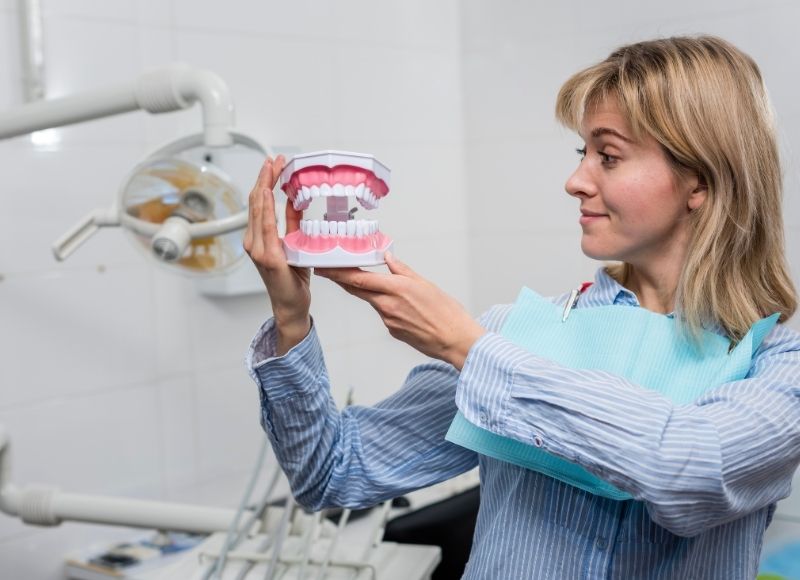
When patients have been using complete dentures or removable partial dentures for some time, they often begin to wonder and research whether a fixed treatment option might be suitable for them. In fact, many patients report that removable partial dentures partially met their needs when they were first made, but over time, issues related to comfort, stability, and long term oral and dental health began to arise. For this reason, online searches about transitioning from removable partial dentures or complete dentures to implant supported fixed prostheses are very common.
In light of everything discussed above, I would also like to explain what patients should consider when transitioning from removable partial dentures to implant supported fixed prostheses. I will try to explain why many patients choose to make this change, how the treatment process generally works, how the jawbone, sinuses, and soft tissues are evaluated for treatment suitability, and what patients can expect during the transition from a removable to a fixed prosthesis. Having a good understanding of these topics will help you make more informed and confident decisions when evaluating the treatment options offered to you together with your dentist.
Whether you are dissatisfied with the comfort of your removable partial denture or complete denture, experience difficulty while eating or speaking, have lost several teeth and have partial edentulism, or are researching implant supported fixed prostheses, the most appropriate treatment decision should not be based solely on information found online or recommendations from others. It should be made following a detailed clinical evaluation by an experienced dentist.
My personal recommendation is that patients who are planning to undergo comprehensive prosthetic treatment should, whenever possible, be evaluated jointly by both a prosthodontist and an oral and maxillofacial surgeon. Successful implant treatment depends not only on placing the implant correctly, but also on proper planning, appropriate prosthetic design, a healthy occlusal relationship, and consideration of long term function. Every patient differs in terms of oral hygiene, gingival phenotype, condition of the existing teeth, previous restorations, bone levels, aesthetic expectations, chewing habits, and functional requirements. In addition, habits such as teeth clenching or grinding (bruxism), loss of vertical dimension over time, and its effects on aesthetic appearance, speech (phonation), and chewing function must also be taken into consideration during treatment planning.
Therefore, the goal of implant supported fixed prosthetic treatment is not simply to replace missing teeth. The aim is to plan the most appropriate treatment for the patient by considering aesthetics, function, biology, and long term durability together. In my opinion, having this approach implemented by an experienced multidisciplinary team is one of the most important factors for the long term success of treatment.
Is It Possible to Switch from a Removable Denture to an Implant Supported Fixed Prosthesis?
The short answer to this question is yes. When suitable conditions are met, many patients who use removable partial dentures or, in some cases, complete dentures can transition to implant supported fixed prosthetic treatment.
The basic principle of implant treatment is that titanium implants placed into the jawbone act as artificial tooth roots, and fixed prostheses are then attached to these implants. Unlike removable systems, the prosthesis is supported by the jawbone and may provide chewing function and everyday comfort that feel much closer to natural teeth.
However, there is an important point to remember: not every patient who uses a removable denture is automatically a suitable candidate for implant treatment. Likewise, having used removable dentures for many years does not necessarily mean that implant treatment is no longer possible.
Suitability for implant treatment is determined by evaluating several factors together, including the volume and density of the jawbone, gum health, condition of the remaining natural teeth, general health status, medications, smoking habits, and habits such as teeth clenching or grinding (bruxism).
For this reason, general information found online or the experiences of other patients are not sufficient to determine the most appropriate treatment option for you. Implant treatment must be planned individually for each patient.
The first step in proper planning is a detailed clinical examination. During this examination, we do not simply look at the number of missing teeth. The bite relationship, condition of existing prostheses, aesthetic expectations, chewing function, and oral hygiene are also evaluated together. This is followed by a panoramic X ray and, in many cases, three dimensional dental tomography (CBCT) to assess the volume and density of the jawbone and its suitability for implant placement in detail.
Sometimes patients think, “I have been using removable dentures for years, so I can no longer have implants,” or “I was told that I have bone loss, so it is too late for me.” However, thanks to advances in surgical techniques, additional procedures such as bone grafting or sinus lifting can be performed when necessary, allowing many patients to receive successful implant treatment. Of course, such decisions can only be made after a detailed clinical evaluation.
In conclusion, transitioning from a removable denture to an implant supported fixed prosthesis may be possible for many patients. However, the important question is not “Can implants be placed?” but rather “Is implant treatment the right option for you?” The answer can only be determined through a comprehensive examination and an individually tailored treatment plan prepared by an experienced team.
Why Do Patients Consider Replacing Their Removable Dentures Over Time?
Removable partial dentures have been safely used for many years as a successful and accessible treatment option for replacing one or more missing teeth. When patients are appropriately selected, they can provide satisfactory results in terms of both function and aesthetics.
However, some patients may notice over the months or years that their removable dentures no longer provide the same level of comfort they did initially. This does not necessarily mean that the prosthesis has failed. Rather, it is often an expected consequence of natural biological changes that occur in the mouth over time.
Following tooth extraction, loss of jawbone volume (bone resorption) may cause the area supporting the removable denture to change shape over time. As a result, the denture may no longer fit as securely as before. It may move while eating or speaking, cause sore spots on the gums, or make the patient feel less confident.
Some patients may also be aesthetically concerned about visible clasps, particularly in the front region. In addition, difficulty eating hard foods, having to remove the denture regularly for cleaning, or worrying that it might move out of place in social situations may affect quality of life over time.
None of these situations mean that a removable denture is an incorrect treatment option. They are natural changes that may occur over the years in many patients who use removable dentures. However, when these changes begin to affect daily life, it may be beneficial to discuss alternative treatment options, such as implant supported fixed prostheses, with your dentist.

Why Is Sufficient Jawbone Important for Implant Treatment?
One of the most important factors we evaluate when planning implant treatment is the quantity and quality of the jawbone in the area where the implant will be placed. This is because an implant requires sufficient surrounding bone tissue to achieve adequate initial stability and function successfully for many years.
After a tooth is lost, the jawbone that once surrounded it naturally begins to lose volume over time. One of the main reasons for this is that the chewing forces previously transmitted to the jawbone through the natural tooth root are no longer transferred to that area in the same way. Over time, this process, known as bone resorption, may progress, causing the jawbone in the edentulous area to decrease in both width and height.
This may be more pronounced in patients who have used removable partial dentures or complete dentures for many years. However, loss of jawbone does not necessarily mean that implants cannot be placed. What matters is accurately assessing the existing bone structure and, when necessary, rebuilding deficient bone tissue before implant treatment or at the time the implants are placed.
For this purpose, advanced surgical procedures such as bone grafting may be used in some patients. Particularly in the posterior regions of the upper jaw, there may not be sufficient bone height for implant placement because the amount of bone decreases after tooth loss and the sinus cavity may expand toward the affected area. In suitable patients, a sinus lift procedure can be performed to create the bone volume required for implant placement.
Of course, bone grafting or sinus lifting is not necessary for every implant patient. Once again, the key factor is individualised implant planning. The patient's existing bone volume and structure, the planned positions of the implants, and the requirements of the fixed prosthesis to be placed on them must all be evaluated together.
For this reason, in addition to the clinical examination before implant treatment, evaluating the jawbone with three dimensional dental tomography (CBCT) is highly important when indicated. This allows us to answer not only the question, “Is there enough bone to place an implant?” but also the much more important question: “Is there sufficient and appropriate bone structure to place the implants in the correct positions so that they can support the planned fixed prosthesis for many years?”
Successful implant treatment is not simply about placing an implant wherever bone is available. The primary objective is to plan the implants in positions that meet the aesthetic, functional, and biomechanical requirements of the fixed prosthesis that will be placed on them.
What Are the Differences Between Removable Dentures and Implant Supported Fixed Prostheses?
When deciding between a removable denture and an implant supported fixed prosthesis, it is not enough to consider only the cost of treatment or how long it will take to complete. Daily comfort, chewing function, aesthetic expectations, maintenance requirements, and long term use should also be evaluated together.
Stability and comfort: One of the most important advantages of implant supported fixed prostheses is that they remain fixed in the mouth. They are not expected to move or become dislodged while eating or speaking. Removable partial dentures, even when successfully designed and fabricated, may receive support from both the remaining teeth and the soft tissues in edentulous areas. Changes in the jawbone and soft tissues over the years may therefore affect their fit and stability.
Preservation of the jawbone: Following the loss of natural teeth, bone resorption may occur over time in edentulous areas. Implants transfer some of the forces generated during chewing directly to the jawbone, providing functional loading of the bone around the implants. With removable dentures, the way forces are transferred and the pattern of loading on the bone are different. Therefore, rather than considering implants to have exactly the same effect as natural tooth roots or as a mechanism that completely prevents bone loss, it is more accurate to view them as an important factor that contributes to the preservation of the bone surrounding the implants.
Maintenance and oral hygiene: Removable dentures need to be taken out of the mouth for daily cleaning. In addition, changes in oral tissues over time may create a need for adjustment, relining, or replacement of the denture. Implant supported fixed prostheses, on the other hand, are not removed by the patient. However, this does not mean that maintenance is less important. Regular cleaning around the implants and fixed prosthesis, the use of appropriate interdental cleaning tools, and professional check ups at recommended intervals are extremely important for long term success.
Aesthetics: Today, highly successful aesthetic results can be achieved with both removable and implant supported prostheses. However, the absence of visible clasps or other removable denture attachment components, together with the fact that the restoration remains fixed in the mouth, may provide a more natural appearance and feel for some patients. The final aesthetic result should be evaluated in relation to the patient's existing teeth, lip support, amount of bone and gum loss, smile line, and personal expectations.
Long term use: Well planned dental implants that receive regular follow up care can function successfully for many years. However, implant treatment should not be regarded as a treatment that will “last a lifetime without requiring any maintenance.” The lifespan of the implant itself and the prosthesis placed on the implant may not be the same, and over the years, some components of the prosthesis may require maintenance, repair, or replacement. Similarly, removable dentures may need to be adjusted or replaced periodically due to changes in oral tissues.
Ultimately, there is no single answer that applies to everyone when asking, “Which is better: a removable denture or an implant supported fixed prosthesis?” Both treatments have specific indications and areas of use in modern prosthodontics. The important consideration is to evaluate the condition of the patient's existing teeth, jawbone, gum health, oral hygiene, general health, aesthetic and functional expectations, and lifestyle together.
For this reason, the key question for me is not “Which prosthesis is better?” but “Which treatment is right for this patient?”
Conclusion: Not the Best Treatment, but the Right Treatment for You
At the end of this two part article that I have written on behalf of ETH Dental, the main idea I want to convey is actually quite simple: there is no single answer that applies to everyone when asking, “Removable dentures or implant supported fixed prostheses?”
While removable dentures may be the right and successful treatment option for some patients, an implant supported fixed prosthesis may be a much more appropriate choice for another patient who meets the necessary conditions, particularly in terms of chewing, speaking, aesthetics, comfort, and quality of life.
For this reason, I recommend making your treatment decision not only by considering your circumstances today, but also by thinking about how you want to eat, speak, smile, and what kind of quality of life you want to have in the years ahead.
And perhaps the entire article can be summarised in a single sentence:
The philosophy we embrace as the ETH Dental Clinic team is that there is no such thing as the best prosthesis; there is a properly evaluated patient and a correctly planned treatment tailored specifically to that patient.